
Many women attended the spontaneous demonstrations that followed the murder of the leader of the opposition, Belaid, and his funeral. Many, however, also attended the march of the supporters of the Islamist party in power. Story of three days of an extraordinary turnout in the streets of Tunis
Tunisian women in the streets
mourning, protest and pride
Tunis – Popular tabloids, the French-speaking Le Quotidien and the Arabic-speaking one Assarih, decided to highlight the image of Chokri Belaid’s daughter, an 8-year-old little girl with resolute eyes, standing between soldiers on the hearse that carried the body of her father, a well-known lawyer, leader of the radical left and tenacious opponent of the Ennahdha Islamist party which came into power in Tunisia with the first free elections after the revolution. What took place on the 8th of February, two days after unknown assassins killed the leader near his house, did not look at all like a state funeral: the ceremonial order of the funeral procession was repeatedly upset by the crowd’s pressure, while banners, songs and clenched fists were reminiscent of a demonstration of the opposing left. But it did not resemble a Muslim funeral either, with all those women and girls, bareheaded and in the front line, mixed with the men, shouting slogans at the top of their voice and coming into the cemetery, where women are usually not admitted.
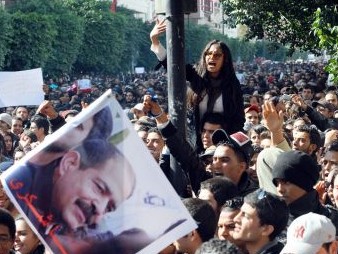 There were women of all ages marching amid factories, highway overpasses and unpretentious dwellings in the working-class district of Djebel Jelloud: young girls with their mothers, students with their boyfriends, professional women with their male colleagues, nurses wearing their white coats, teachers wearing jeans, women in fashionable clothes or in traditional garb. There were many women also among the lawyers who were marching clad in their gowns. Here and there a few hijabs could be seen among the marchers: an elegant one by Chanel, a bold orange one, a classic one in muted colours. By a curious retaliation of history on that day the secularized and modernistic part of Tunisia hailed with satisfaction any voilée who joined the march, exactly as colonial France, not so long ago, had rejoiced in each woman who shed her headscarf. But most of the women who were wearing a headscarf were gathered outside the march, on the edges of the streets and on the roof terraces: they were the women of the district, who were watching in silence.
A different scene had appeared two days before on Avenue Bourguiba, when the news of the murder, which had taken place early in the morning, had spread with customary speed on the computer network, and a small crowd had promptly gathered in front of the Ministry of Internal Affairs and was constantly growing. This crowd was quite diversified, in the age, social origin and political affiliation of its components and was characterised by a complete mixitéof sexes: it was very similar to the revolutionary crowd of14thof January 2011, but this time it had coalesced on the basis of the rejection of murder as a political weapon. There were conversations between people who did not know each other, who sometimes got excited and sometimes disagreed; but nobody would have dreamed of starting a gender-based issue. On that symbolic Boulevard, where anyone who had a camera could go wherever he or she wished, shooting close-up photographsof policemen in anti-riot gear or standing right in front of a moving tank, young female journalists, with or without a hijab, expertly flitted about with their equipment. Actually, it was because of a photograph too many that I found myself in the middle of a tear gas cloud, until a female friend dragged me into the safety of a café. The place was one of those cafés maures that are frequented only by men, sanctuaries of masculinity that my female Tunisian friends sometimes try to conquer. This time, the customers remained unruffled.
Again, a different scene appeared the day after the funeral, along the same Avenue Bourguiba. On that occasion, the demonstrators were activists and supporters of Ennhadha. They had been authorised, rather than called, by the party: its headquarters, for two days, had been the meeting place for eager young people who wished both to protect the rooms (because in the provinces several headquarters had been set on fire) and to assert their right to use public spaces. Thus some thousands of individuals had gathered (a number that cannot be compared with that of the crowd for the funeral, at least ten times larger), mainly bearing the red national flags, but also the green Palestinian and the black Islamic ones. Here, too, a great number of women were present, and again they were of all ages and of several backgrounds. But this time the vast majority of them wore the hijab, and the bareheaded ones were a small minority: the exact opposite of the march of the previous day. On the symbolic stairs of the Tunis Municipal Theatre, a favourite place of younger demonstrators at any time, there was a crowd of women and girls with multi-coloured clothes and headscarves deftly draped in a variety of fashions, accompanied by their male friends and partners who were improvising rap music that almost drowned out the official speeches, a few metres away. The girls, who had quickly mastered a post-modern communication language, chanted ironic slogans against France and used the national flag as a headscarf: they seemed to be turning (unconsciously?) to their westernized female contemporaries, as if to say, “See? We can do it too…”.
Thus after three days of leaden skies and bitter cold, of mourning and street fighting, on that Saturday afternoon, the avenue, kissed by a friendly sun, seemed to be occupied by a popular festival, with families and vendors of kaki and popcorn. Once again, lookers-on could not avoid noticing that there was the most complete sexual mixité: in the thick of the crowd, men and women were closely packed, but there never was a single gesture or look that denied the naturalness of this shared presence. The demonstration was against violence, in defence of institutional legitimacy; but it was also a display of Muslim pride (one of the slogans was “The people is Muslim”) and party support (“We will vote for Ennahdha again!” was another one). The event, with a masterly stroke, was closed both by the national anthem and the Muslim profession of faith; a great red cloth (the colour of the national flag) was unfolded above people’s heads while they repeated the Creed of the Muslim Brotherhood. Then, as at the end of a festival, suddenly large family groups were reunited, its members finding each other and hurrying away in groups, to get back to their homes in the suburbs before nightfall.