
If we continue to ignore the value of what cannot be priced, such as care work and the protection of the environment, we risk compromising our collective future. The only way to change course is through a different economic lens: that of feminist economics. We discussed these themes with Danish writer and activist Emma Holten, starting from her book Deficit: How Feminist Economics Can Change Our World
The value of
the invaluable
If we are unable to assign proper value to the things that truly matter in our lives, how can we hope to build a better future?
This is the central question posed by Emma Holten in her thought-provoking essay Deficit: How Feminist Economics Can Change Our World, published in Italian by La Tartaruga in 2025.
A Danish-born feminist activist and gender policy consultant, Holten makes her publishing debut with Deficit, first released in Danish in 2024. The book has received widespread acclaim, including the 2024 Politiken Literature Prize. In addition to Italian, it has been translated into English, Swedish, Norwegian, German and Dutch, with six further translations currently underway.
Written in clear and accessible language, Deficit traces the history of economics as a so-called “science”, from the Enlightenment to the present day. Holten reveals how mainstream economic models – which continue to shape political decision-making – have consistently disregarded the value of care work, typically carried out by women. She also examines the broader tendency to devalue what cannot easily be priced – such as environmental preservation, natural resources, or even leisure time.
But Holten’s book doesn’t stop at critique. Deficit offers a powerful alternative: a call to move beyond outdated economic paradigms and embrace feminist economics as a path forward.
During the launch of Deficit at Libreria Tuba in Rome – where Holten spoke in conversation with economist Marcella Corsi – we had the chance to speak with the author and delve deeper into the core themes of her work.
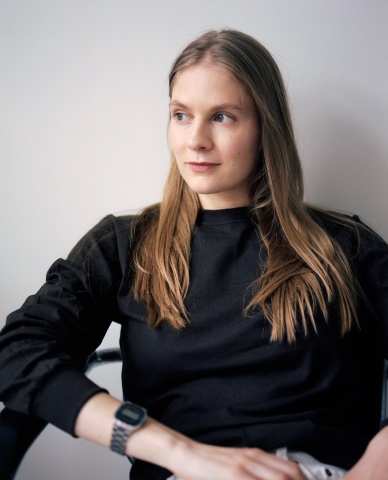
Your book was in part a response to a 2020 article claiming that women represent a net 'deficit' to society due to factors like maternity leave and part-time employment. How did encountering this argument shape your motivation to write Deficit, and what does it reveal about how gender biases are embedded in economic policy and thinking?
The headline reveals two things to me. First of all, the power of economic language to shape our conversations. When citizens see a headline like that, it seems like hard science. How did that happen? That is the first questions I wanted to answer. The second is of course what this says about economics’ understanding of value. It becomes clear that the activities women spend time on are not seen as particularly important contributions to an economy. I show that this is because the work of taking care of people for free and for money has been systematically overlooked and devalued in economics since its very beginnings.
In Deficit, you take aim at economic models that have traditionally overlooked or dismissed care work and what’s traditionally seen as 'women’s work.' How have these frameworks influenced the way society defines women's value, and what impact has this had on women’s economic and social standing?
We often talk of economics as a science that describes the functioning of the world. But in my analysis, it becomes clear that it also shapes the world. When we use models and methods that devalue care work, it creates institutions and cultures that devalue the people who perform care work: women. This creates a tremendous paradox in women’s lives, because they are constantly working, yet never seem to become rich from work. This challenges a fundamental assumption in economics: that creating value makes you wealthy. There is not a single country in the world where women are wealthier than men, yet they work more hours a day almost everywhere.
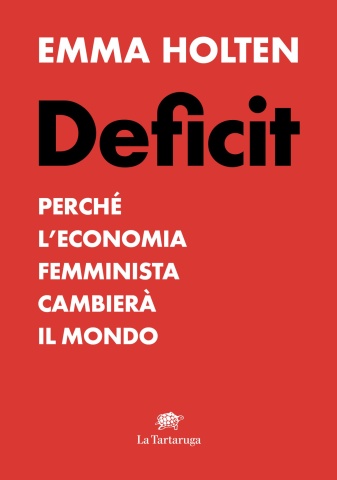
Your book opens by sharing a private event: in the first lines, you recount being diagnosed with a chronic illness, and how this suddenly made you a person in need of more care. This personal event takes on a public meaning, as an awakening to a condition of vulnerability – something our societies still struggle to acknowledge.
I definitely think covering up the vulnerability of the body is an important instrument of power in our economic conversations. Economic models have an idealised vision of the human being: she is never ill, old, a child or struggling mentally. This creates policies that leave no space and resources for these conditions, even though they are an integral part of being alive. This creates a terrible spiral, where vulnerability disappears from the public consciousness, and then we cannot organise around it politically. It becomes shameful. And due to this, we instead live in a society of constant optimisation: working out, eating healthy, dedicating yourself to improving and being perfect. In reality, it comes from a deep seated fear and self-hatred. We know that vulnerable people suffer, yet instead of ending their suffering, we fight our whole lives to not become them.
What impact have Silvia Federici’s works, which you have also translated into Danish, had on the reflections you present in your book?
I cannot even begin to describe it. She is the most important feminist to my thinking. Her analyses, of course, are very important to me, but I think her way of understanding the relationship between culture and economics is the most central. In Federici’s thinking, we cannot separate the economic structure of a society from the structure of the family and the place of women. In most conversations today, we separate questions of “identity and culture” and questions of “economics” into two different piles. I think Federici has shown us so clearly why that is a huge mistake.
In your book, you discuss the idea that equating feminist liberation solely with increased participation in the workforce can be limiting, especially when it overlooks the redistribution of care responsibilities. How can feminist economics offer a more inclusive and equitable vision for both women and men in society?
I think feminism often finds itself in a little bit of a catch 22! Women must do paid work in order to liberate themselves from the grip of their fathers or partners and go their own way if they wish. Yet, as is clear from men’s lives, working does not necessarily mean freedom. It can just mean a new form of oppression. From that point of view, I see a lot of potential in the lives women are leading currently: spending more time at home and in their communities, and less time in paid work on average. I think this should be a goal for men too. It would increase equality in the labour market, give men closer relationships with their families and ease women’s burden of unpaid work. Also, long term, it could decrease material consumption.
In Deficit, you frequently reference data from Denmark, your home country, but Italy also appears prominently. These two countries are often seen as worlds apart when it comes to welfare models and rank very differently in terms of women’s employment and emancipation. Yet, you suggest they share a common attitude toward care work. What connects them in this regard, despite their apparent differences?
The economic ideas that I describe in my book have been incredibly powerful all over the world. They are at the heart of the IMF, the World Bank and the EU, and the modern understanding of what capitalist “success” looks like. Yet, there are of course divergences of degree in different countries. But what has become more and more central is that the core of the issues are extremely similar. Every capitalist economy seeks to devalue care work as much as possible to get it as cheaply as possible, yet at the same time demands that it is done. In some countries, like Denmark, we have had some successes in countering this, for example with very generous parental leave. But like labour rights, protecting nature etc. it is a power struggle to achieve these things. What this shows is that the questions of what is valuable is a political one, not a bureaucratic one.
In the book, you write, 'It is not hard to see that nature and unpaid care work are fellow sufferers in GDP.' How does the economic invisibility of both care work and the environment reflect a broader logic of extraction – one that not only devalues human labour, especially women’s, but also fuels the exploitation of natural resources and deepens the climate crisis?
This was a really important point for me to get into the book: we often talk about the marketplace as a sphere where value is created. But when you look deeper, what the market often does it take something that has no market price (unpaid care, natural resources or free time, for example) and transforms them into products with a price. Suddenly, in economic logic, we have value and increased GDP. But in reality, we might lose more than we gain.
Could you give us a real-life example of this pattern?
In Italy, I often think of the bagni all along your coast. As a Dane, it is quite striking. In my country, beaches are not for profit, they are for everyone, run by the local councils and volunteers. In terms of economics, the bagni make the beach a “value creator” because sunbathing gets a price, but it also makes them inaccessible to poor people. I think both structures are political choices, but in economics, one is seen as vastly more valuable than the other. We have no language for the value of that which has no price, and that makes it very difficult to imagine a society where there is more free time and nature, it would look like we were getting poorer.