
Throughout the history of technology, gender stereotypes have been so deep-rooted that they have often outweighed even market interests, delaying innovation within an economy shaped by cultural assumptions about masculinity. We spoke with financial journalist and bestselling author Katrine Kielos, whose work explores how sexist thinking continues to shape — and hold back — the evolution of intelligence
Mothers of invention
with Katrine Kielos
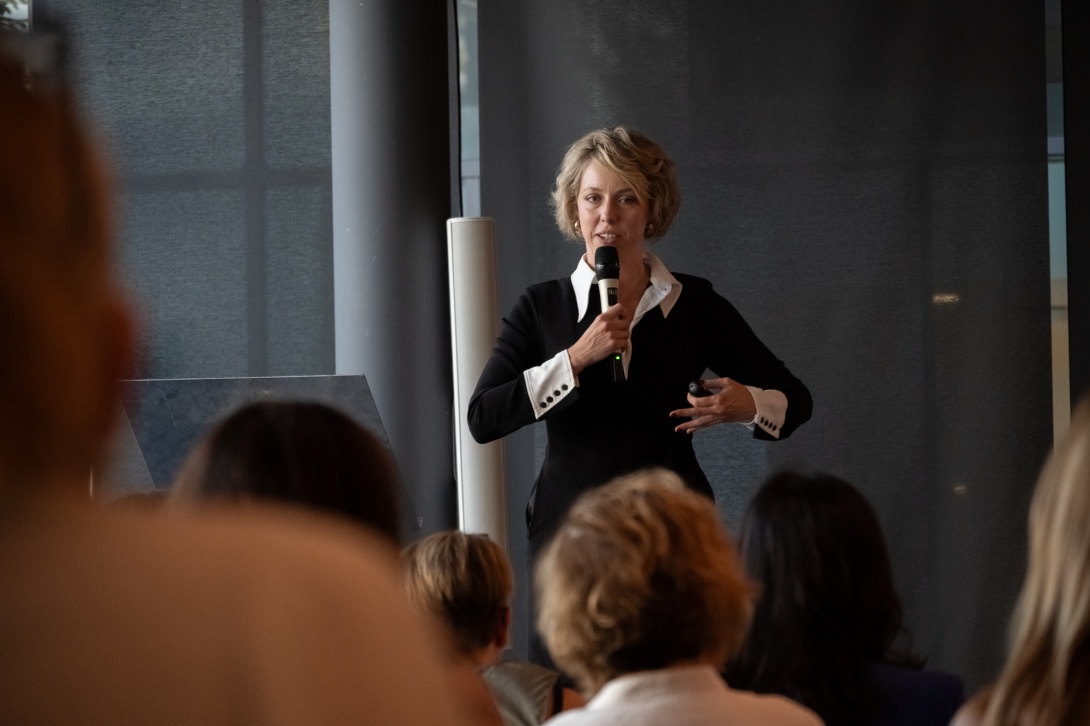
How have our ideas about masculinity shaped technology over the centuries — and how might we reimagine innovation for a future that places women’s intelligence at its centre, rather than excluding it as has long been the case in an economy designed by men, for men? We spoke to Swedish journalist and author Katrine Marçal, whose bestselling books Who Cooked Adam Smith’s Dinner? and Mother of Invention explore the intricate relationship between gender, economics and creativity. The conversation took place on the occasion of her participation in Prossima: The Future of Innovation Is Plural, an event organised by inGenere in September at the Milano Luiss Hub, which brought together a network of Italian female entrepreneurs, innovators and policy experts to rethink technology through a feminist lens.
In your book Mother of Invention you begin with the commercial history of the wheeled suitcase, showing how gender-role stereotypes can be so deeply rooted in culture that they outweigh even clear market interests, delaying the adoption of innovations in an economy shaped by our assumptions about masculinity. The idea that men must carry heavy things prevented us from seeing the potential of a product that went on to transform not only the experience of female solo travelers, but the entire global industry. Is this still happening today, is sexism holding back innovation?
Yes. It's hard to prove, like I'm able to show with the historical examples in my book, because we're talking about things that don't get funding right now, or things that are not supported, or things that are not believed in. But yes, I do think it's happening, which is why I wrote the book. And I think telling these historic examples of what we missed out on because of these ideas about gender is a way to show how much is at stake right now. And I think the clearest indication for that this is happening is how little investment goes into female founders all over Europe and all over the world, really. We're talking about how 2% of all venture capital goes to women, and that means we're missing out on a lot.
How many good ideas have been lost in our male-designed, male-oriented economies that bet everything on fossil fuels, dismissing inventions such as the electric car as a diversion for ladies?
I think the way we talk about innovation, or particularly how we have talked about innovation in the last 15, 20 years, is with these very kind of traditional masculine words. “Move fast and break things” was the old Facebook motto. Innovation should “crush” and “disrupt” and all of these things. And I think that discourse is quite unhelpful, because innovation is about problem solving. So why don't we talk about it in terms of repairing, helping, fixing and so on? I think innovation defined in those terms certainly shapes what it becomes, and shapes what technology becomes – that's a big point in my book. I think, particularly in economics, we tend to look at technology and innovation as this almost neutral force that all we can do is sort of predict: “where is AI going?”, as if it was, I don't know, the weather. But what I'm trying to show with these examples in the book is that we are making AI, we are making the cars, we are funding these ideas or we're not funding them. And it's human choice, and they are embedded in human society and all of that shapes what it becomes. The words we use about it shapes what it becomes.
In what ways do you believe a stronger presence of women in innovation could help drive the evolution of our species toward a fairer and more sustainable society?
I do think more money to women and more money to women's ideas. Firstly I think just from a meritocratic perspective it makes a lot of sense. A lot of innovation research can show that the person who is on a daily basis dealing with a problem is also more likely to find a solution for that problem. And you have women in many parts of society and in particular parts of the labour market and within companies that are dealing with problems and are therefore the best people to come up with solutions for those problems. So I think that certainly needs to be addressed. And then there's also the bigger question that you raise, would innovation if it was more inclusive also be something else? And I do think so.
How do you imagine it — and what present perceptions shape that vision?
I'm from Sweden, and worked a bit with the Stockholm Royal School of Technology on these things. But well before that they had these problems with attracting students to an innovation incubator. And they had mainly men applying and this was a huge problem. So they sat down and they thought what should we do? And they tried this really simple thing which was just using different words. So instead of sort of putting up big posters at the university – Are you the new Elon Musk? Do you have an idea that can change the world? Do you have what it takes? Are you an entrepreneur? – they cut all of that language out and instead they started talking about, you know, do you want to come and solve this problem with us? Do you feel you can contribute to this? And all of a sudden, not only did they have more women applying to this innovation incubator, they also had more men. So this sort of more inclusive, sort of more cooperative sounding language around innovation doesn't just attract women, it also attracts more men. And we want the most talent and the best talent and the best people, right?
If we think of the art world, as you have pointed out in your talks, the same creative gesture is often valued differently depending on whether it is associated with men or with women—celebrated as “art” in one case, dismissed as “craftwork” in the other, with inevitable consequences for the market value of the works. Could a different culture of innovation subvert the value we assign to things? What does “innovation” mean from your perspective, and why is it so important to rethink the meaning of this word through a feminist lens?
It's important because it's about the future. You know, the ideas of today are what are creating tomorrow. When we see these figures, 98% of all venture capital goes to men or women have problems getting investments and so on, that means that solutions by women are not going to be part of the future. And that's very serious. And I do think it's very, very important. The bigger issue that you raise the example about how we value art differently based on if it's made by men and women, that's a big problem that's been with us for a long time and that certainly comes with us into innovation. And I think it's important to be aware that we all have these, we carry these biases, which is why it's so important to talk about these things. And the examples in my book, you know, the people who dismiss the rolling suitcase, you know, they're probably not conscious of it. They're just like, that's a bad idea. I don't feel it. I don't want to, you know, I don't think I'll be able to sell that. I don't think that's going to work. And they didn't know why they thought that. And obviously retrospectively, it's quite easy for someone like me to go back and show, okay, they thought this because of this. But when you're in it, you don't see it. And it's all the things, all the things we don't see. And it's about looking in places you wouldn't look. And it's about actually, just being conscious and being very motivated to do this work because you acknowledge that it is about the future. And you know, the future is, it's important.
In your analysis you connect the history of industry—and the technologies we use every day—with beliefs about gender and the division of roles. Making this connection so explicit reveals, for example, how it has shaped wage gaps and skill gaps in the labour market. Perhaps we should start thinking of ideas as objects manufactured to meet the needs of specific subjects, rather than continuing to treat them as neutral truths falling from the cosmos. After all, this has been a central argument in feminist epistemology. Which authors or readings have most shaped your perspective in this regard?
I actually really like reading female science fiction authors. Or science fiction authors who sort of come from a slightly different perspective, because that is about the imagination and imagination about technology and what it is. And they do tend to write quite differently and more human-focused, relationship-focused, seeing technology as something... I mean, Ursula Le Guin used to talk about this. Bodies, nature, you know, and that technology is... Tables are technology. Bags are technology. So, this much wider definition of it. So, I do recommend reading science fiction by women.
What do you see as the future of innovation in a world where men still control most of the resources and therefore continue to hold the power to determine what technology is, how much it is worth, and what it should be used for? Which ongoing transformations do you consider most important to watch in order to redefine the future of intelligence?
This is unsurprising coming from a financial journalist, but I do think that the financial sector is key, because where the money goes and the logic it follows and the incentives it has is of tremendous importance. So, I do think there are a couple of levers within the financial system that you can pull and also alternative financial logics you can create. I do think sort of follow the money is not the only thing, but I do think that is a very good starting point. And I also think that in that context, the sort of more macro picture here, which is that women are actually going to have more capital in the next couple of decades, particularly in the Western world, because women live longer, they're going to inherit quite a lot of money from the big baby boom generation. So, we will have quite an unprecedented situation within one or two decades where women actually have much more capital and women using that capital could make a huge difference, transformation, I hope. So, I do think, yes, money.
Behind the scenes at the Milan event, you mentioned that you’ve been working on a new book due to be published soon — can you give us a little preview?
Yes, it's going to print in Sweden and it's about the stories that shape women's relationship to money on a collective, economic, and conscious level. So, it's about, basically, I call five stories, and I argue that they still, even though we think we've made so much progress, they still profoundly shape how women see their own worth. And then I take them and I debunk them. So, it will be the story of the male breadwinner, this idea that we have that men were always breadwinners, and women were in the cave, and men were providing with meat, dragging it back to the cave. So, I kind of debunk that. I talk about why that's not true and why we want to believe it and how it shapes us, that we still have this almost unconscious idea that financial security has to come through men. Well, historically, that has not been the case. Women have almost always worked, both not for money and for money, and this idea that there's a traditional model that women were home and the men were out making the money, that's not traditional, because it just wasn't the case for a majority of the population.
What other myths do we need to debunk?
So, I talk about that.I talk about the myth of this idea that the oldest profession, this idea that prostitution is the oldest profession, is not true. It's something that British author Richard Kipling made up in the 1800s, and we believe it. So, we have this connection between that if a woman earns money, it has to be connected to sex, so it has to be connected to shame, and therefore women feel all sorts of things. I talk about, well, this is probably a connection to innovation, sort of the myth of the men are daring and women are more careful, which is not quite true either, if you look at the economic research and how we actually respond and how we view risk. There's a small difference, but this is also how we measure it. So, I kind of confront that. I talk about aging. It's a huge problem in Europe that kind of ageism is a new sexism, that women are dismissed at a much earlier age than men, both on the labor market and seen as less valuable when we age. Where does that idea come from? What does it do to women? And I talk about this other, you know, the fifth story in the book is this idea that women could become like men, so that if women only, if we got the same education as men and got the same jobs as men, we would earn as much as men, and that has just not happened, and why has it not happened? So, these are underlying kind of stories that shape our sense of our own worth and our sense of our own kind of security in life. So, I guess the premise of the book is that our relationship to money is very emotional and goes very deep and shapes a lot of things in our lives. So, yes, it's called A Woman's Worth, The Economic Gaslighting of Women. It's coming out in Sweden this autumn.
Wow, that’s really exciting. We hope your works would be soon translated into Italian.
Yes, well, my agent will be starting selling rights now in October at the Frankfurt Book Fair.